

Most AI adoptions I see start the same way. Pick a coding assistant, buy a seat for every engineer, send the announcement. A few months later the delivery numbers look about the same, and nobody can point at what went wrong, because on paper nothing did. I’ve seen this scenario while working with tens of clients now and it sounds weird every time...
Usage was never the missing piece. The 2025 Stack Overflow Developer Survey found that 84% of developers use or plan to use AI tools, while only a fraction trust the accuracy of what those tools produce.
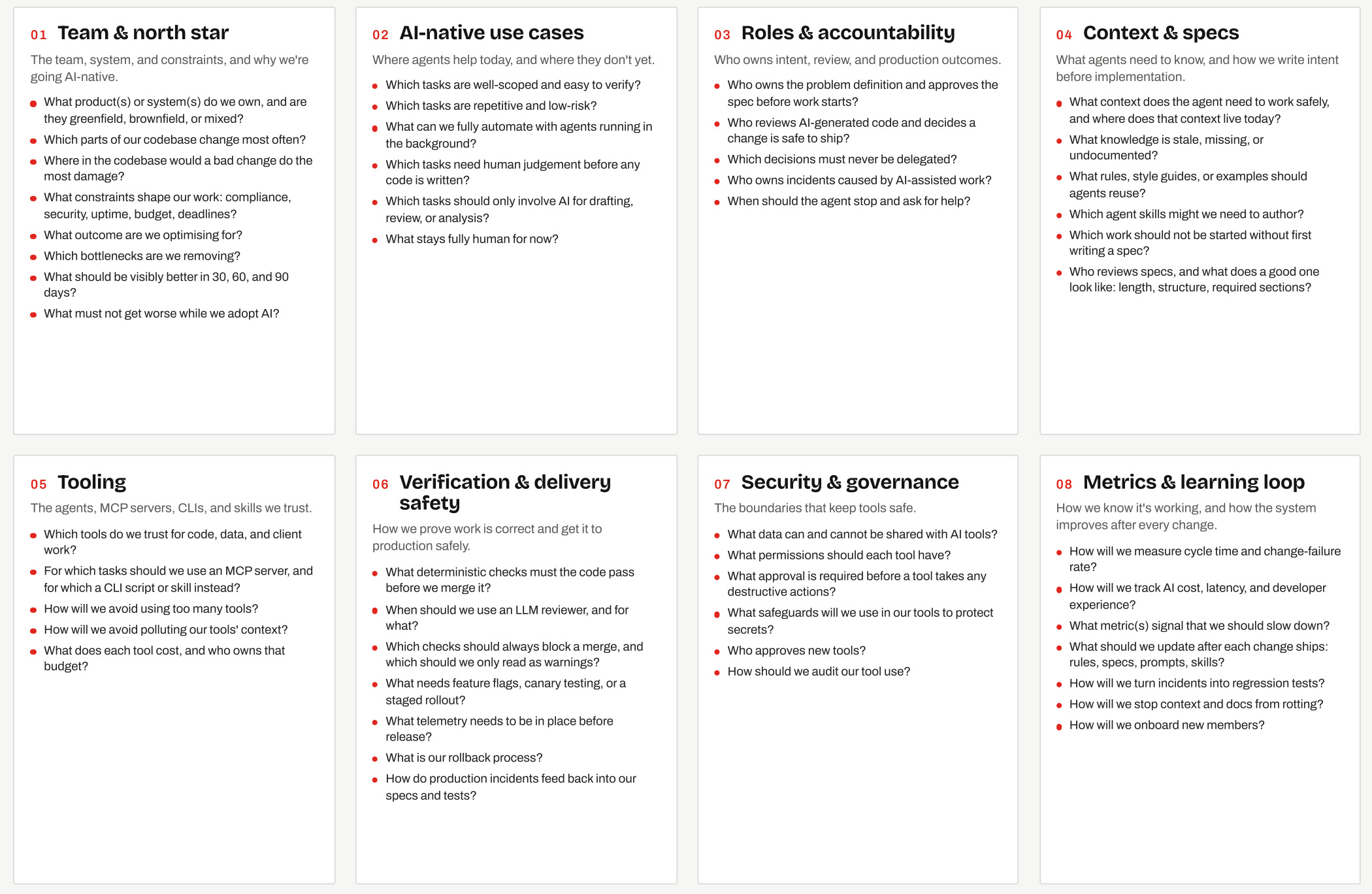
I built the AI-Native Team Canvas so a team can answer all their questions about AI usage together.
If you have seen the Business Model Canvas, you know the shape. It takes a big fuzzy question (”what is our business?”) and breaks it into boxes with prompts, so a group can reason about it together instead of arguing in circles.
This canvas does that for a different question: how does our team want to adopt AI-native engineering? The eight areas are:
Team and north star: what you own, what constrains you, and why you’re doing this at all
AI-native use cases: where agents help today, and what stays human
Roles and accountability: who owns intent, review, and production outcomes
Context and specs: what agents need to know, and who writes it down
Tooling: the agents, MCP servers, CLIs, and skills you trust
Verification and delivery safety: how you prove the work is correct and ship it safely
Security and governance: the boundaries that keep the tools safe
Metrics and learning loop: how you know it’s working, and how it improves
The canvas gives you no answers: what’s right for a bank with compliance boundaries and a fifteen-year-old monolith is not right for a five-person team on a greenfield service. It gives you the questions you can’t skip, and a shape for the conversation.
How to run it
Book 60 to 90 minutes for the first pass, depending on how much you disagree. Later passes are shorter.
Get the engineers and a lead in the room, plus at least one voice from product or design. Bain’s 2025 report puts coding and testing at roughly 25 to 35% of the software development lifecycle (I cannot agree more...), so a team where only engineering gets faster has mostly moved its queue somewhere else (reviews, decisions from product and so on).
Some outputs from this session belongs in the repo. Agreed conventions go into AGENTS.md or your tool config. Spec rules go into the specs folder. Every unresolved disagreement becomes a ticket with a name on it so that you can solve what’s still pending ;)
It works asynchronously as well: drop it into a repo doc or a Slack thread, let people annotate on their own time, and meet only for the points where you disagree :D
The blanks are the useful part
When a box comes out empty, sort it before you fix it, because the two kinds of gap have different fixes.
A skill gap means people can’t do it yet. Nobody on the team has written a spec an agent can follow, or reviewed agent output well enough to catch the plausible-but-wrong version. You close it by practising next to someone who already has the skill.
A system gap means the people are perfectly capable and there’s no shared artifact. No spec format, no shared context file, no rule about what gets reviewed, no single agent everyone uses. You close it with a standard, which is what most of the canvas boxes describe.
Almost every adoption problem I run into is one or the other, and enablement won’t fix a missing standard.
If nobody in the room can change a team standard, you’ll produce a list of grievances rather than a set of decisions. Bring whoever can say yes (like your Tech Lead, Staff Engineers etc).
Go run it
The canvas is free at alfonsograziano.it/aine-canvas. Download the PDF, print it, or screenshot it into Miro.
The best moment to run it is at the start of a project, before habits harden. If your team is new to AI-native engineering and the tools are already rolling out, run it this week instead. The list of gaps you come out with is the roadmap for everything that follows.
P.s. if you have any feedback on the canvas, I’d love to hear your thoughts! You can reach out on Linkedin or send me an email at info@alfonsograziano.it